Best Free Expense Splitting Apps in India: Splitwise vs Zedger vs Tricount (2026)
Honest comparison of Splitwise, Zedger, and Tricount for splitting expenses in India. Real experiences with roommates, family trips, and household bills.

Arun Andiselvam

Let me guess — you just came back from a trip with friends, or maybe you moved into a new flat with roommates, and now there's that awkward moment. "Bhai, tera kitna hua?" Someone paid for the cab, someone else for the hotel, another person covered dinner. Now everyone's doing mental math and nobody knows who actually owes what.
Or maybe it's a different situation entirely. You're living with your parents, everyone chips in for groceries and bills, but there's no system. Your mom paid the electricity bill, you ordered groceries on BigBasket, your dad paid the building maintenance. At the end of the month, it's chaos.
I've been in both situations, and I've tried pretty much every expense splitting app out there. So here's my honest take on the three apps that actually work in India — Splitwise, Zedger, and Tricount.
The Reality of Splitting Expenses in India
Before I get into the apps, let's talk about something these apps don't always understand: Indians don't split expenses like Americans or Europeans.
When my college friends and I went to Goa, we didn't care about splitting things equally. Rohit always books hotels because he has that HDFC card with discounts. Neha handles food because she knows what everyone eats. I usually get stuck with cabs and entry tickets. At the end, we figure it out. We don't need "who paid for whose drink at the club" level detail.
But when it comes to family expenses? That's different. My parents don't want to "settle up" with me. We just need to know where the money is going each month. That's a completely different use case.
Most expense apps are built for the first scenario — friends splitting bills. Very few understand the second one.
Splitwise: The One Everyone Knows
Let's start with the obvious choice. When you ask anyone about expense splitting apps, Splitwise is the first name that comes up. It's been around since 2011, and there's a good chance half your friend group already has it installed.
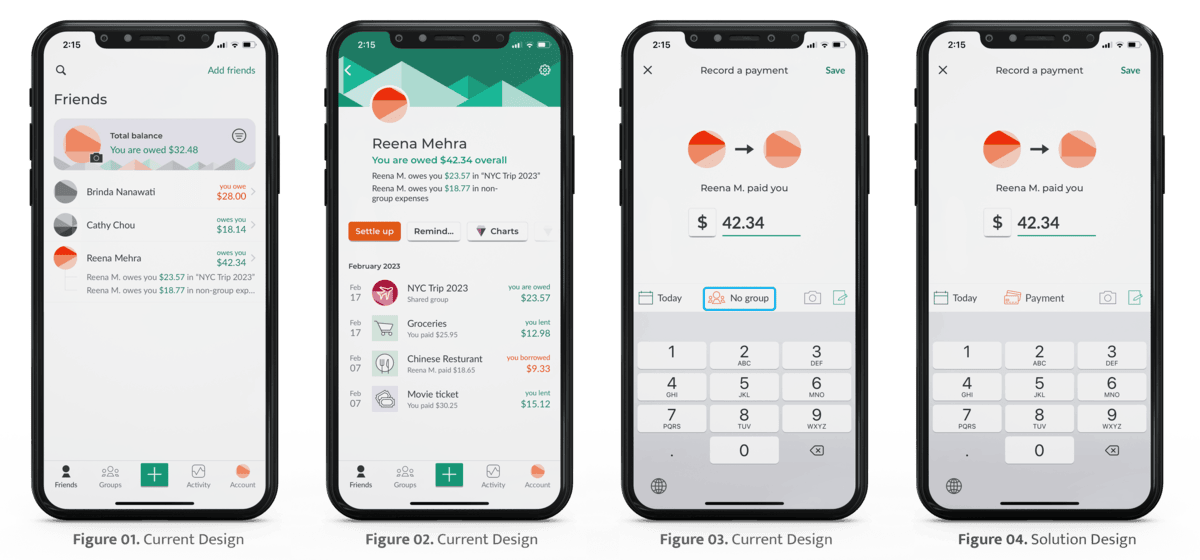
What I actually like about it:
The simplicity is genuine. You add an expense, select who it's split between, and you're done. The interface hasn't changed much over the years because it doesn't need to. When someone new joins your trip group, they probably already have the app, which means less convincing needed.
The "simplify debts" feature is genuinely useful. If A owes B ₹500, B owes C ₹300, and C owes A ₹200, Splitwise figures out the minimum number of payments needed to settle everything. For complicated trips with multiple people, this saves headaches.
Where it falls apart for me:
Here's the thing — Splitwise used to be completely free. Then they added a Pro version with some extra features. Fair enough, developers need to eat. But now? The free version limits you to 5 expenses per day.
Five. Expenses. Per day.
On our last Manali trip, we hit that limit by lunch on day one. Breakfast, chai stop, petrol, toll, lunch — done. And this is a free app? We ended up writing expenses on someone's notes app and bulk-adding them later, which defeats the purpose.
Also, there's no offline mode. We were in Spiti Valley with zero network for three days. Couldn't add anything until we got back to civilization.
The Pro subscription is ₹999 per year. Not crazy expensive, but it stings when the app used to do everything for free.
Who should use Splitwise:
Honestly? If your friend group already uses it and you only split expenses occasionally — a dinner here, a movie there — it's fine. The daily limit won't bother you. But for trips or regular household expenses, it gets frustrating fast.
Zedger: Built for How Indians Actually Do Things
I'll be upfront — Zedger is made by an Indian team, and it shows. Not in a "Make in India" token way, but in how the app actually thinks about money.
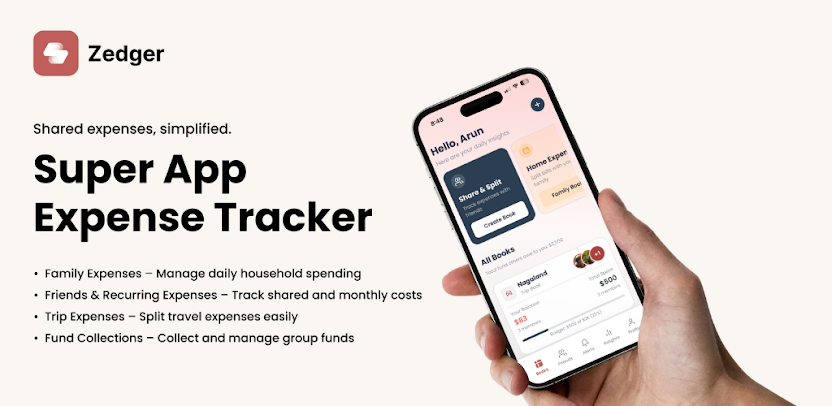
What makes it different:
The first thing I noticed is that Zedger doesn't force everything into the "split and settle" model. It has this concept of different "books" for different purposes. A Family Book works differently from a Friends Trip book.
In my family, we don't settle up. We don't keep score. We just want to know where the household money is going — who paid for groceries, who covered the maid's salary, who paid the WiFi bill. Zedger's Family Book gets this. You can track expenses without the app constantly telling someone "you owe ₹2,347."
For trips with friends, there's a separate mode that works more like Splitwise — track everything, calculate who owes whom, settle at the end.
The offline mode has saved me multiple times. Add expenses when you're in the middle of nowhere, and it syncs when you get network. On the Spiti trip I mentioned earlier, this was the difference between useful and useless.
No daily limits on the free version. I've added 20+ expenses in a day during trips without any paywall popup. You can check out all Zedger's features if you're curious about what else it offers.
What I wish was better:
It's newer, so not everyone has heard of it. Getting friends to install a new app is always a small battle. "Splitwise toh hai na, why this one?"
There's no web version yet. If you want to check your expenses on a laptop, you're out of luck. Everything is mobile only.
The app does show ads in the free version, though they're pretty infrequent. Not like those apps where you watch 30 seconds of some fantasy game ad every time you open them.
Who should use Zedger:
If you're tracking expenses with family — especially in a joint family setup where multiple people contribute to household costs — this actually understands your situation. Same for roommates managing rent, utilities, and groceries. The free version is genuinely usable without feeling crippled.
Download Zedger - Expense Tracker if you want to try it.
Tricount: The Quick and Dirty Option
Tricount comes from Belgium and is huge in Europe. It's found its way to India mostly through travelers who discovered it abroad.
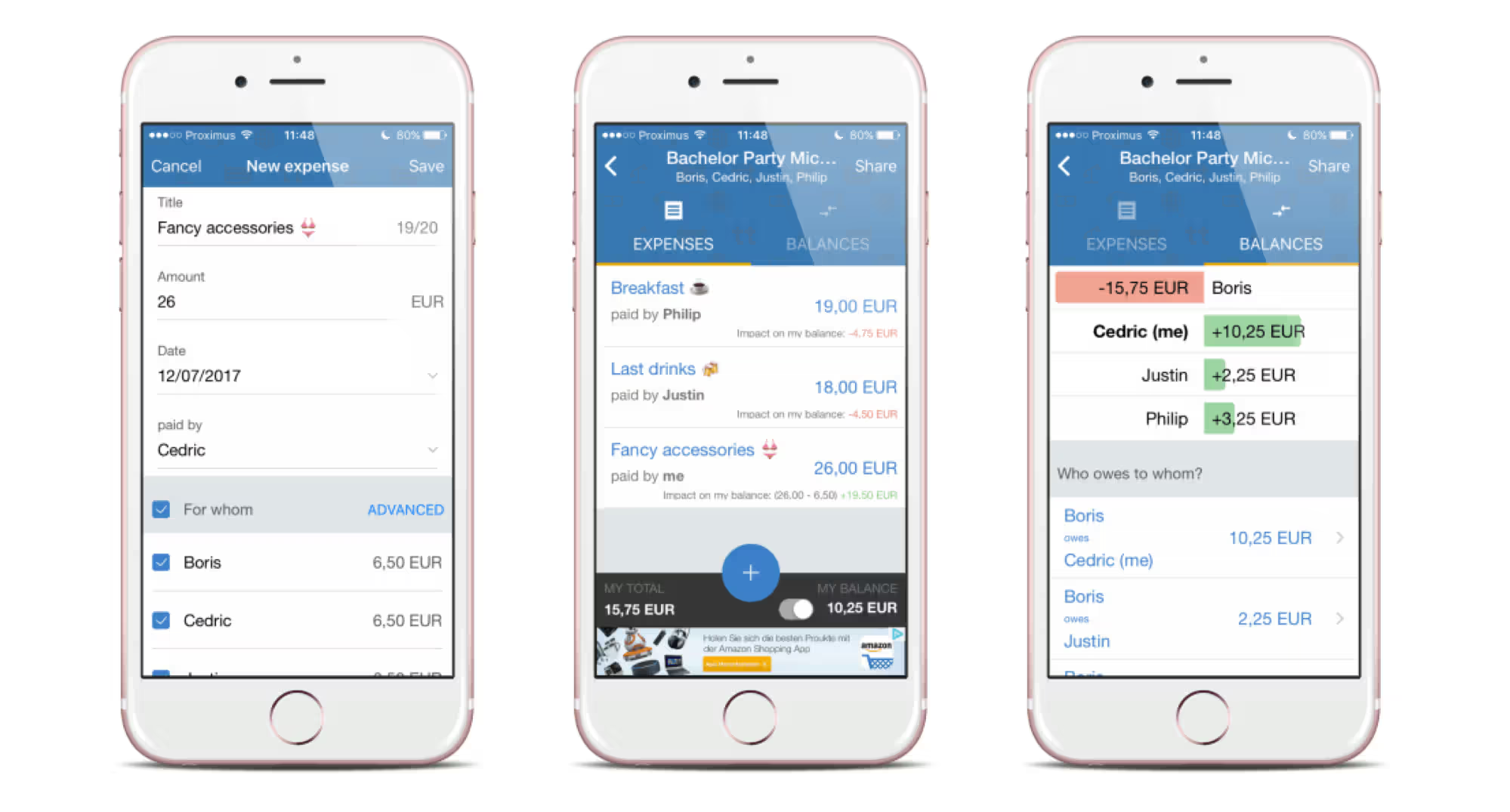
What's actually good:
You don't need to create an account. Open the app, create a group, share a code or link with friends, and start adding expenses. For a one-time trip where you'll never use the app again, this is perfect.
The interface is dead simple. Almost too simple. Add expense, who paid, how to split, done. No features to confuse you.
Offline works well, which is essential for travel.
Where it doesn't work:
Everything about this app screams "designed for Europeans on a weekend trip." The currency conversions, the payment suggestions, even the visual design feels European.
There are no recurring expense options. If you're using this for monthly roommate expenses, you'll be manually adding rent and electricity every single month.
It's purely designed for temporary groups. Using this for ongoing family expense tracking would be miserable.
The features are basic. If you want to split something unequally — like "I had the fancy cocktail so I'll pay more" — good luck figuring that out.
Who should use Tricount:
Going on a short trip with people who don't want to install yet another app or create accounts? Tricount works. Use it for the trip, settle up, delete it, move on with life.
Real Scenarios: Which App Wins?
Let me break this down by actual situations you might be in.
Scenario 1: The Goa Trip with College Friends
You're going on a 4-day trip. Eight people. Different combinations of people paying for different things.
- Splitwise: Will work, but you'll hit the daily limit. Someone will need Pro, or you'll be writing things down to add later.
- Zedger: Trip Book mode handles this well. No limits, works offline when you're at that beach shack with no signal.
- Tricount: Actually a solid option here. Quick setup, no accounts needed, share a link in the WhatsApp group and you're running.
Scenario 2: Living with Roommates
Three people sharing a flat in Bangalore. Rent is split three ways, but electricity depends on AC usage. One person handles cook payments, another deals with WiFi.
- Splitwise: Works if you stay under 5 expenses daily. Recurring expense feature locked behind Pro.
- Zedger: Monthly Recurring book type is literally made for this. Split rent equally, utilities by percentage, track everything in one place.
- Tricount: Too basic for ongoing household management. You'll get tired of it in two months.
Scenario 3: Family Household Expenses
You live with parents. Everyone contributes to running the house. You want to track where money goes, not who owes whom.
- Splitwise: Awkward. It keeps showing your mom that she "owes" your dad money. That's not how families work.
- Zedger: Family Book mode gets this. It's a shared ledger, not a debt tracker. You can see monthly summaries without the awkward "settle up" notifications.
- Tricount: Not designed for this at all.
Scenario 4: Collecting Money for a Gift or Event
Your friend is getting married. You're collecting money from 15 people for a group gift.
- Splitwise: Clunky for this purpose. It's not really designed for collections.
- Zedger: Has a "Money Collection" book type specifically for this. Track who's paid, who hasn't, without the debt calculation.
- Tricount: Won't work well here.
Cost Breakdown (2026 Prices)
Let's talk money, because apps change their pricing constantly.
Splitwise
- Free: Limited to 5 expenses per day, basic features
- Pro: ₹999/year — unlocks unlimited expenses, receipt scanning, recurring expenses
Zedger
- Free: All core features, up to 4 books with 5 members each
- Pro: $1/month — more books and members, priority features
- VIP: $1.99/month — unlimited everything
Tricount
- Free: Full features
- No paid tier
For what it's worth, Zedger's paid plans are significantly cheaper than Splitwise Pro. But honestly, Zedger's free tier is complete enough that I haven't felt the need to upgrade.
My Honest Recommendation
There's no single "best" app. It depends on your situation.
Use Splitwise if your friend circle already has it and you only split expenses occasionally. Fighting against network effects is exhausting. If everyone already uses Splitwise and you only split dinner bills once a week, just use Splitwise.
Use Zedger if you're tracking family expenses, living with roommates, or go on trips frequently enough that Splitwise's daily limit becomes annoying. It's the only app that genuinely understands Indian family dynamics.
Use Tricount for one-off trips with people you won't share expenses with regularly. No commitment, no account creation, no friction.
Personally, I've settled on Zedger for family and roommate stuff, and I still have Splitwise installed because some friend groups refuse to switch. That's the reality — you'll probably end up using more than one.
The expense splitting app market in India is still figuring itself out. None of these apps are perfect. But at least now you have options beyond just accepting Splitwise's limitations.
Have you tried any of these apps? I'm curious what's worked for you — especially if you've found good solutions for family expense tracking. Drop your experiences in the comments or reach out to me.
Tags: